Ghosts in the Edit Bay: The Parallel Films Living Inside Every Finished Cut
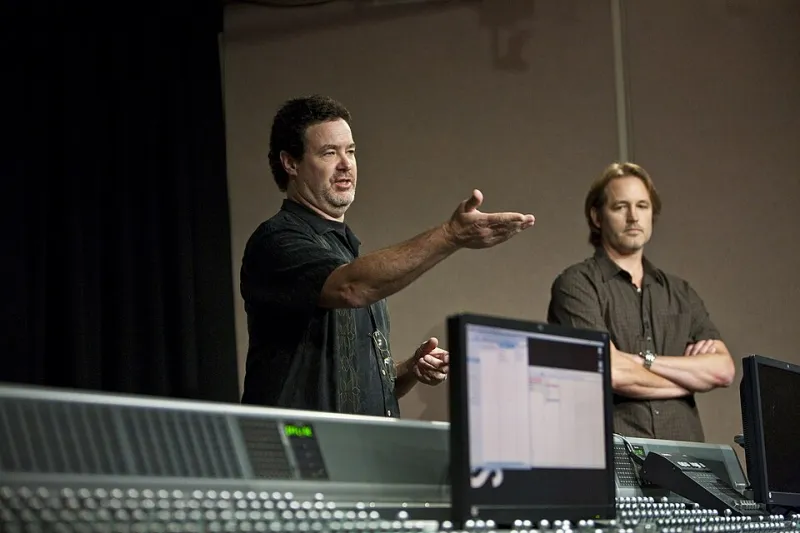
Photo: Vancouver Film School, CC BY 2.0, via Wikimedia Commons
There is a particular kind of silence that settles over an edit bay in the final days before a film is locked. It is not the silence of completion. It is something closer to the silence of surrender — the moment when a director releases their grip on every version of the film that might have been and accepts, with varying degrees of peace, the one that is.
Every finished film is, in a precise and unsentimental sense, a graveyard of alternatives. The scenes that were written and never shot. The performances that were captured and never used. The structural choices made under deadline pressure that quietly redirected the entire emotional logic of the story. These are not simply casualties of the production process. They are evidence — a record of the distance between intention and execution that every serious filmmaker must eventually learn to read.
The Three Films That Always Exist
Before a single frame is examined, it helps to acknowledge that filmmaking consistently produces not one film but at least three distinct works existing in parallel.
The first is the film of the imagination — the one that existed in full before production began, vivid and uncompromised, shaped entirely by the director's internal vision. This film is often the most emotionally coherent version. It has never had to accommodate a location that fell through, a cast member whose availability narrowed the shooting window, or the physical reality of a budget that proved insufficient for the third act.
The second is the film of the footage — the raw, unassembled record of what was actually captured. This version is democratic and indifferent. It contains brilliant moments the script never anticipated alongside compromised ones the script never foresaw. It is neither the director's vision nor the final product. It is raw material, and its relationship to the imagined film is often startling in both directions.
The third is the film of the audience — the version that exists only in the act of reception, shaped by individual experience, cultural context, and the particular emotional state of the person in the seat. This film is permanently beyond a director's control, which is precisely what makes it the most humbling of the three.
The finished cut lives in the negotiation between these versions. And the unmade film — the one that haunts the edit bay — is the composite of everything that was lost in that negotiation.
What the Assembly Cut Reveals
The assembly cut is among the most psychologically demanding documents in any filmmaker's career. It is the moment when the imagined film and the footage film first meet on the same timeline, and the collision is rarely comfortable.
Assembly cuts are almost always too long, too uneven, and structurally revealing in ways that no script reading could have predicted. Scenes that read with tremendous momentum on the page frequently stall on screen. Transitions that seemed obvious during production become murky. Performances that felt electric on set sometimes recede into the surrounding material when deprived of the energy of the room.
But the assembly cut also reveals something else: the accidental film. Sequences that were never intended to carry emotional weight frequently emerge as the most affecting material in the rough cut. A quiet reaction shot becomes the emotional center of a scene. A piece of ambient dialogue captured during a setup becomes the clearest expression of a character's interiority. The footage is, in this sense, more generous than the director often deserves.
Learning to read an assembly cut with genuine honesty — not as a record of failure but as a map of possibility — is one of the most demanding skills in the craft.
The Archaeology of Compromise
Every cut made in the editing room is, on some level, a negotiation with compromise. This is not a pejorative observation. Compromise, in the creative context, is simply the process by which an artist reconciles what they wanted with what they have.
The productive question is not whether compromise occurred — it always does — but rather which compromises were strategic and which were concessive. Strategic compromise involves trading one element for a stronger version of another. Concessive compromise involves surrendering something of genuine value because time, resources, or confidence ran short.
Filmmakers who develop the discipline to distinguish between these two categories in their own work gain something invaluable: the ability to identify, with precision, what their next film must protect. The unmade film inside a finished cut is not simply a record of what was lost. It is a detailed brief for what must be preserved going forward.
The Director's Cut as Diagnostic Tool
The phrase "director's cut" has acquired a somewhat mythologized status in American cinema, often associated with restored footage and extended runtimes. But the more useful conception of a director's cut is not a version of the film with more material — it is a version of the film with more intentionality.
A director's cut, properly understood, is the version in which every decision traces directly back to a deliberate artistic choice rather than a logistical accommodation. It is the film in which the compromises were all strategic rather than concessive. It is, by definition, a film that may never fully exist — but the act of imagining it with precision is among the most clarifying exercises a filmmaker can undertake.
Asking yourself what your director's cut would look like is not an exercise in nostalgia or regret. It is a diagnostic process. It forces you to identify the specific moments where your original intention diverged from your final execution, and to articulate — honestly, without self-justification — why that divergence occurred.
Reading the Gap as Growth
The distance between the film you imagined and the film you finished is not a measure of failure. It is a measure of your current position in the development of your craft.
Early in a filmmaker's career, that distance tends to be large and somewhat chaotic — the gap is wide because the tools available to close it are still being developed. As craft matures, the gap often narrows, not because the imagination becomes less ambitious, but because the filmmaker develops greater fluency in translating interior vision into exterior form.
But the gap never closes entirely. And the filmmakers who claim otherwise are either working beneath their own ambition or are no longer looking honestly at their work.
The phantom film inside every finished cut — the one made from restored intentions, recovered performances, and the structural choices that time pressure foreclosed — is not a reproach. It is a compass. It tells you where you were aiming when the work began, and it invites you to examine, with rigor and without sentimentality, how close you came.
That examination is not the end of the process. It is, in the most meaningful sense, where the next film begins.